The Cruise Experience
Definition and Conceptualization
The modern cruise experience must be defined and conceptualized on the basis of diverse interpretative criteria.
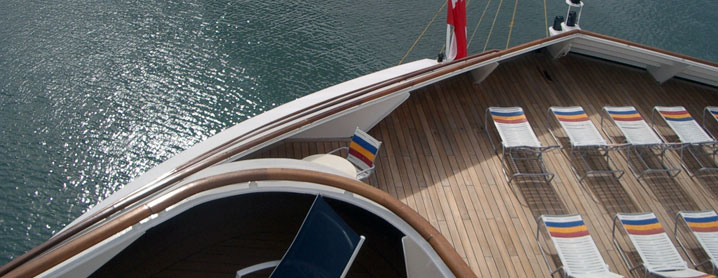
The modern cruise experience must be defined and conceptualized on the basis of diverse interpretative criteria.
There are diverse questions concerning the very nature of the cruise experience, which have given place to different definitions and interpretations of the realities and aspects around the cruise industry and its services.
For Cartwright and Baird (1999), the definition focuses on the motivation, and cruises must not be considered as a mere travel between origin and destination, but as part of a whole of services offered by leisure and holiday companies.
For Butler (2003), the central element of cruising is the onboard accommodation and services, and not the cruise ship as a mean of maritime transport.
Douglas & Douglas (2004) understand the cruise as a type of sea voyage in which the vessel travels from and to the same place, providing leisure and recreation services to its passengers. Nevertheless, this definition excludes cruise ships with itineraries between different ports, and the passengers that may embark or disembark the cruise during the route.
The Cambridge Dictionary (2005) defines a cruise ship as a large ship, like a hotel, on which people travel on for pleasure.
We consider that there are two main elements when trying to define the exact nature of the cruise experience: the onboard services and facilities, and the cruise itinerary.
Obviously, the services, infrastructure and personnel organization aboard cruise ships are key elements to understand this industry as a part of the maritime sector, which includes diverse and important particularities resulting from its special structure, functioning and objectives. Thus, modern cruise are compared to floating hotels, with as many options as any land-based resort, which provide their passengers with a sensational environment and fully equipped leisure facilities. In the same sense, the nautical nomenclature has been replaced by hospitality terms and expressions (decks – floors, cabins – rooms, etc.). In addition, there are two clearly divided onboard areas, with a wide range of personnel in charge of hotel operations, and which usually outnumbers the navigation and technical staff.
Nevertheless, the importance of routes and destinations that comprise a cruise itinerary should not be underestimated. The growing demand for cruise services includes an also increasing number of tourist that appear to be choosing for new destinations and longer stays in the ports of call, which has made itinerary planners to identify new and more attractive destinations to maintain and stimulate the interest of their potential customers. Therefore, while the onboard facilities and recreation amenities are a very important part of the service provided by cruise companies, the opportunity to enjoy new more stimulating itineraries must be therefore considered as an integral part of the overall cruise experience.
If you are interested in working on cruise ships and looking for the moment to access the sector, do not miss the opportunity to apply for a shipboard position in 2026.
Enter
The maritime cluster offers considerable job opportunities to workers and professionals unemployed or seeking for an occupational change.
Enter
There is a large diversity of positions and jobs to be filled aboard cruise ships.
We would like to offer you a listing of the most in-demand positions in this segment of the maritime sector.
EnterWorking in the cruise sector is an option for an increasing number of people and professionals seeking for a well-remunerated job in a dynamic working environment with career prospects.
Please do not hesitate to contact us.
EnterWe are open to receive – and we shall reply – any inquiry or request for information about the cruise industry and its job opportunities and for career development.

Contact Wind Rose Network
Contact